
Multithreading with emlen
Why multithreading is essential
Multithreading is essential for success in B2B sales. According to Gong, deals that close successfully involve approximately three times more contacts by the second call compared to those that do not close.
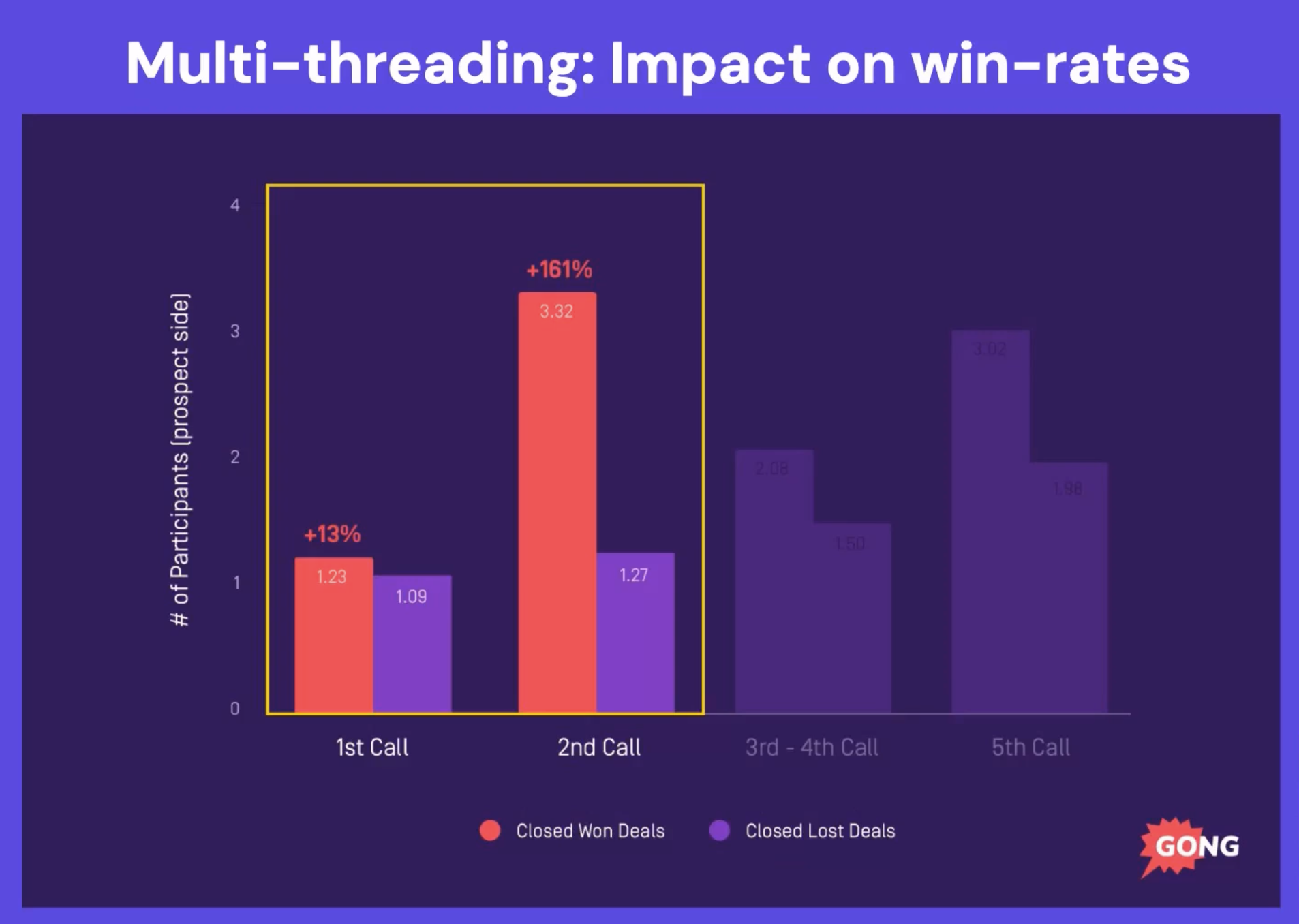
Another key insight: Not engaging decision-makers reduces win rates by 80% in SMB deals and 233% in Enterprise deals (source).
Buying decisions are made by committees, so engaging multiple stakeholders is crucial. Relying on one contact risks stalling the deal. Multithreading secures buy-in and reduces risk, with tools like emlen streamlining communication and collaboration.
The general approach to multithreading
- Identify stakeholders
- Build connections
- Facilitate engagement
emlen is particularly effective for facilitating engagement (step 3) and partially for identifying stakeholders (step 1).
Here is a more granular guide that consists of 6 steps:
Step 1: Identify stakeholders
Research and identify all potential stakeholders involved in the buying process. Typical roles include:
- Initiator: Identifies the need for a solution
- User: The end user of the product or service
- Influencer: Impacts the decision through expertise or authority
- Economic Buyer: Responsible for budget
- Decision Maker: Holds final approval authority
- Gatekeeper: Controls access to information or decision-makers
The person who benefits most from your solution often becomes your sales champion, typically your strongest connection to the buying center.
Furthermore, answer these questions per persona (Buyer Persona Development):
- Demographics: Job title, seniority, department
- Goals: What they want to achieve with the solution
- Pain Points: Challenges in their current workflow
- Decision Criteria: What factors influence their decisions
Build a stakeholder map:
| Demographics | Goals | Pain Points | Decision Criteria | |
| Initiator | ||||
| User | ||||
| Influencer | ||||
| Economic Buyer | ||||
| Decision Maker | ||||
| Gatekeeper |
Pro Tip: With emlen you can identify additional stakeholders if your Destination is shared internally.
2. Engage stakeholders early (optional)
If it feels natural, reach out to other stakeholders before your first call with the primary contact.
Email template:
Hey {{Stakeholder Name}},
We’re scheduled to connect with {{Primary Contact}} on {{Date}} on how {{Your Company}} can {{Business Impact}}.
No ask of you here. I’ll make sure to provide an update after the meeting.
Best,
{{Your Name}}
3. Set expectations with your champion
During your initial call, set clear expectations with your sales champion about involving additional stakeholders. Share a relevant customer success story to explain why multithreading is important.
Example script:
I originally connected with {{champion title}} they had {{issue or strategic initiative}}.
They found that involving their Head of {{department}} was helpful because {{...}}.
Then we involved their VP of {{department}} to {{...}}.
Key Tip: Clearly explain why involving others will benefit the process to gain your champion’s support.
4. Engage and connect with stakeholders
Choose the best engagement approach based on your discussions and intuition. Here are three options:
Option 1: Include them in the next meeting
Example script:
Can I make a recommendation?
How about get your Head of {{department}} on the next call to quantify the problem and understand {{...}}.Assuming this checks the boxes for you, then we get the perspective of your VP and how this fits in with her vision.
This will help you position {{your product or service}} better when it comes to get budget for it.
Option 2: Ask your champion to invite them to the Destination
Example script:
Can I make a recommendation?
How about I add this {{information or document}} to this space.It will help you Head of {{department}} to understand {{...}}.
You can simply share the link with her or use the “Invite others” button.
Option 3: Offer to directly invite them
Example script:
Can I make a recommendation?
How about I add this {{information or document}} to this space.It will help you Head of {{department}} to understand {{...}}.
If you provide me her email address I can share this space with her directly.
5. Keep stakeholders informed
5.1 If engaged before the first call
Send a follow-up email summarizing key points and share the link to the emlen Destination.
Email template:
Hey {{Stakeholder Name}},
I hope you’re well. As mentioned earlier this week, {{Primary Contact}} and I met today, and I’d like to share the key points from our discussion: {{Highlight 1-3}}.
You can access all relevant documents using this link: {{insert link to Destination}}.
Best,
{{Your Name}}
5.2 If they were part of the call.
Follow up individually to address their specific questions.
Email template:
Hey {{Stakeholder Name}},
In the call, you asked me about {{topic}}.
I just added some additional info on this to our space: {{insert link to Destination}}.
Let me know if you have further questions.
Best,
{{Your Name}}
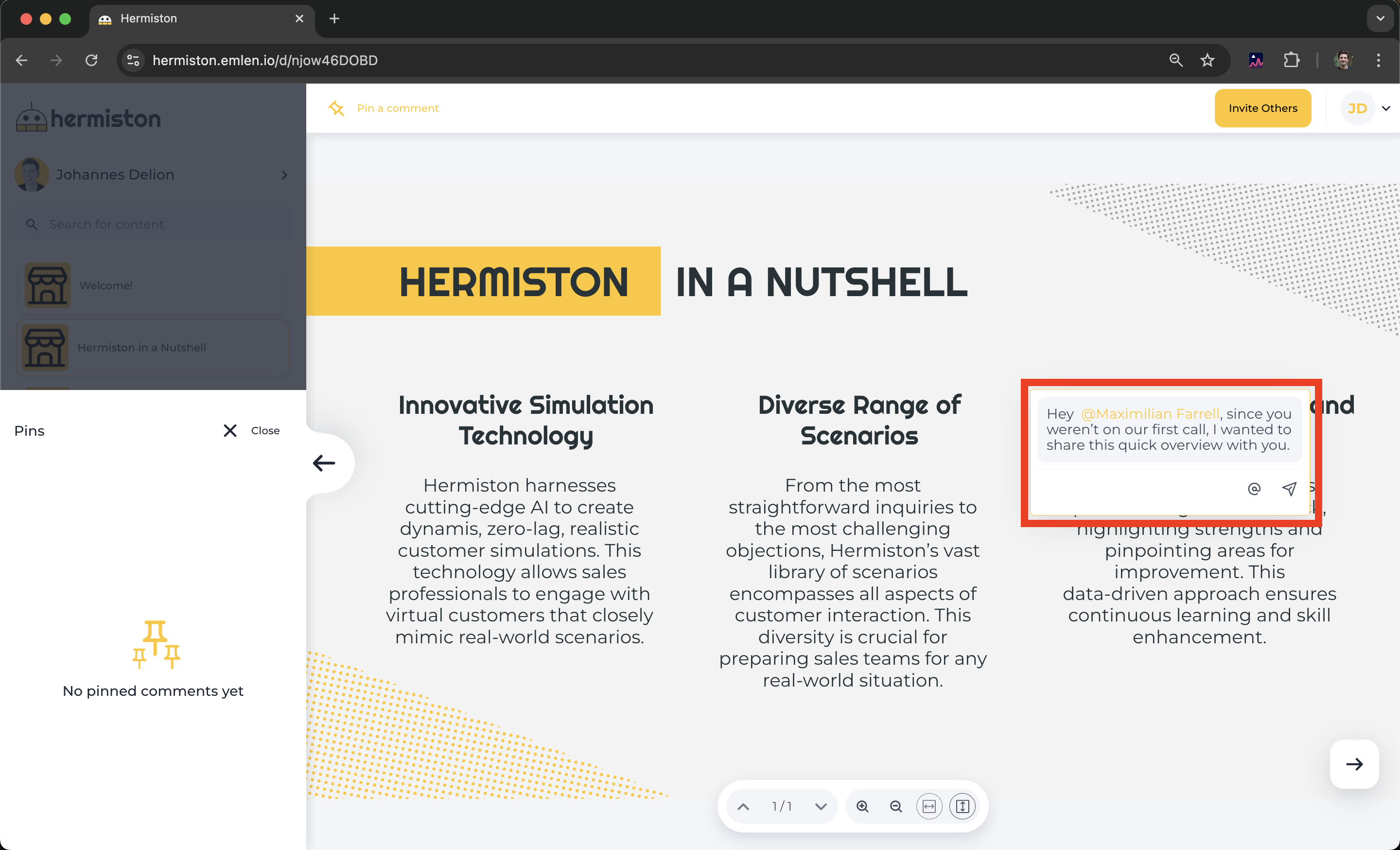
5.3 Use comments and tagging
Guide stakeholders to the right content by tagging them in comments. They’ll receive email notifications prompting them to visit the shared Destination.
6. Track and Manage Them
Use emlen’s tracking features to manage your stakeholders effectively.
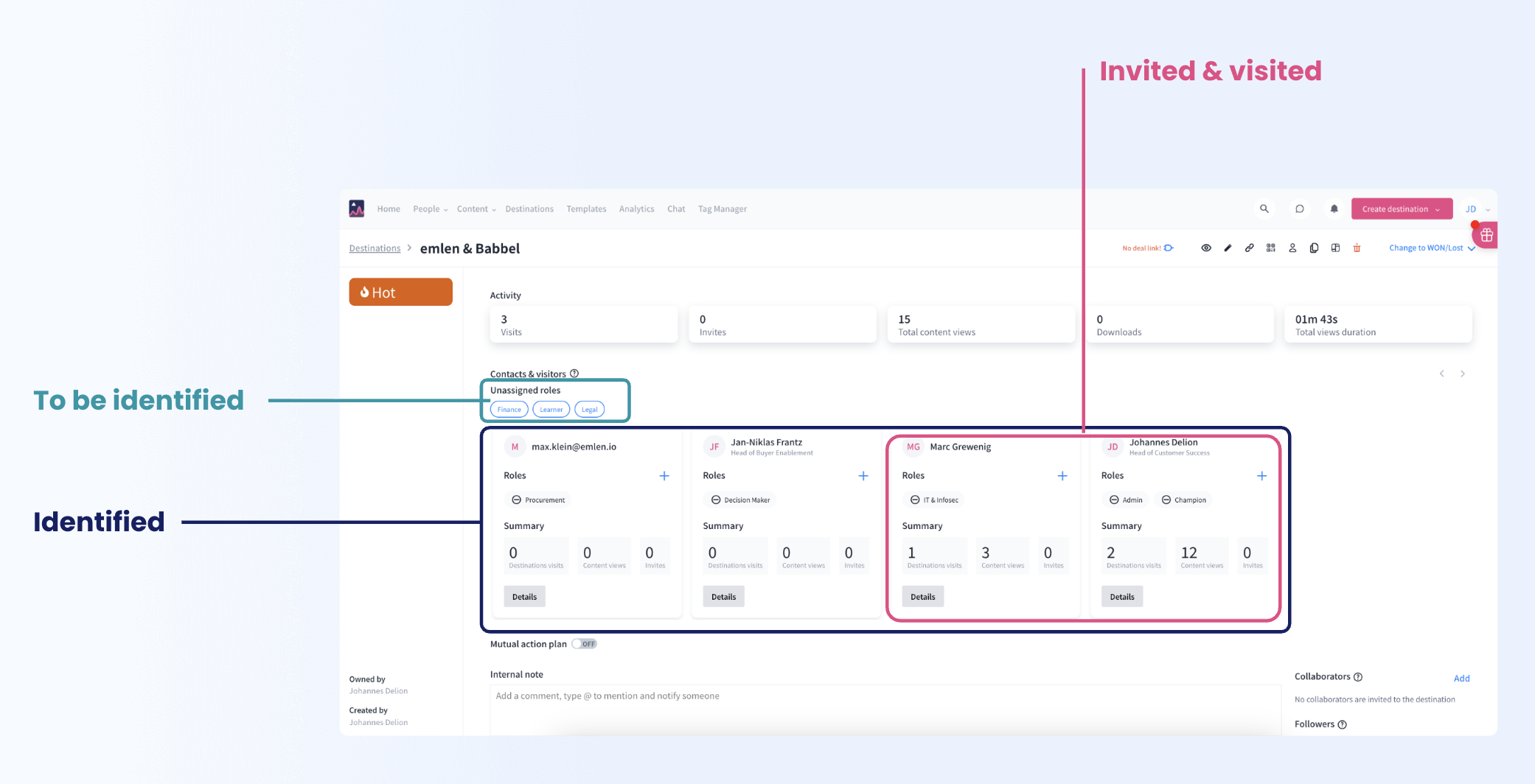
- To be identified: Track stakeholders you need to identify
- Identified: Keep track of identified stakeholders
- Invited & visited: Monitor stakeholders who have been invited and have visited your shared space
Leverage analytics
Focus on stakeholders who show high engagement.
Nurture them
Keep nurturing them by adding product updates, case studies, or other relevant materials to the Destination.
Always supplement with other channels
In addition to using your Digital Sales Room, leverage email, LinkedIn, and phone calls to keep the buying process moving.